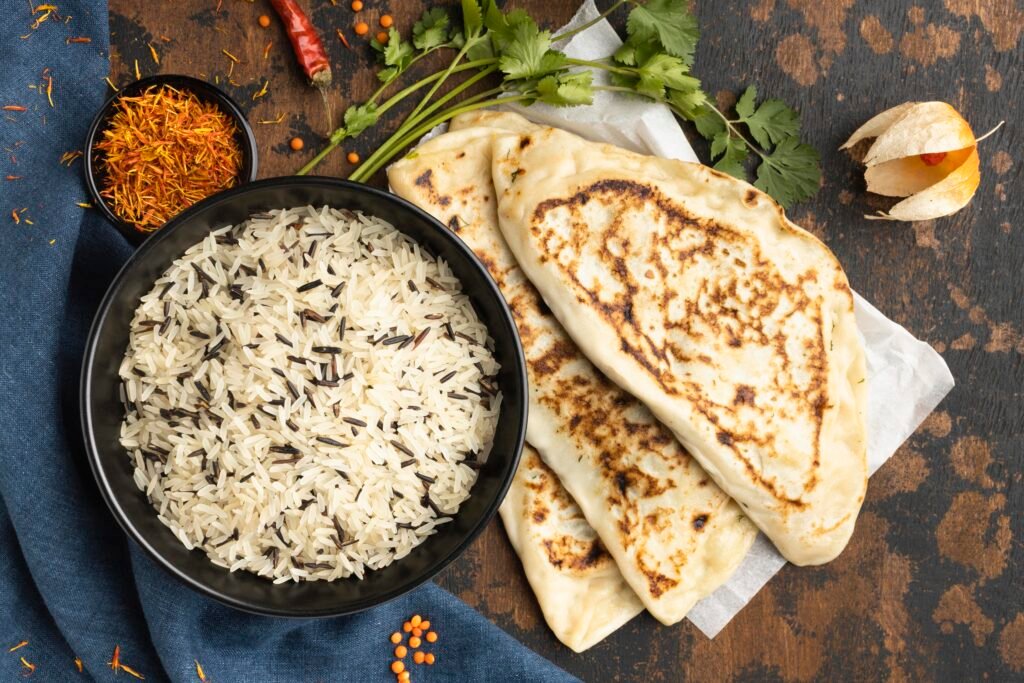
If you are new to Indian food, this can look like a lot of carbs. A basket of naan and a bowl of rice, both on the same table, for the same meal. So why is Indian food served with rice and bread together? Is it tradition, is it habit, or do restaurants just like selling sides?
The real answer is a mix of geography, practicality and plain good eating. At Krish’s Indian Bistro in Sewell, NJ, we get asked this by first-time guests all the time. If you are still deciding what to order at Krish’s Indian Bistro, or want to know the difference between each bread first, our Indian bread guide is a handy companion. Here is the full story.
The Short Answer
Rice and bread do two different jobs. Bread is for scooping thick, rich dishes. Rice is for soaking up thinner, saucier ones. A good Indian meal usually has both kinds of dishes, so it makes sense to have both on the table.
But the reason they ended up together in restaurants goes back to the map of India.
It Started With Geography
India is huge, and its climate changes dramatically from one end to the other.
The north has cool winters and dry plains, which are perfect for growing wheat. So states like Punjab, Haryana and Uttar Pradesh built their meals around bread: roti, paratha, naan and kulcha.
The south and the east are hot, wet and full of rivers, which is ideal for rice. In Tamil Nadu, Kerala, Andhra Pradesh and West Bengal, rice is not a side dish. It is the meal, and everything else is served around it.
For most of history, a family in the south might eat rice two or three times a day and rarely see a roti. A farming family in Punjab would eat roti at every meal and save rice for special occasions.
So Why Do Restaurants Serve Both?
Because an Indian restaurant menu is not from one region. It is a greatest hits collection.
The butter chicken and naan come from the north. The biryani has roots in Hyderabad and Lucknow. The dal might be Punjabi and the vindaloo is from Goa. When all of those sit on one menu, the breads and rice that belong with them come along too.
Over time, eating both became normal in Indian cities as well. Today, plenty of homes across India serve roti and rice in the same meal.
Bread and Rice Do Different Jobs
Indian food is traditionally eaten with the hands, and that explains a lot.
Bread is a spoon you can eat. You tear off a piece, fold it and pinch up some paneer, a kabab or a thick dal. It works best with dishes that hold together: dry vegetable dishes, tandoori meats, and rich gravies like butter chicken or saag.
Rice is a sponge. It catches every drop of a thin, soupy dish like dal tadka, rasam, sambar or a light fish curry. Try picking up a watery dal with a piece of naan and you will see the problem straight away.
The Traditional Order: Bread First, Then Rice
In many North Indian homes there is an unwritten order to the meal. You start with roti and the drier dishes. When the roti is finished, a small serving of rice arrives, and you finish the meal with rice and dal or rice and yogurt.
It is a gentle way to end. Bread is hearty and satisfying. Rice with dal or curd is soft, light and easy to digest. Think of it as two courses built into one plate.
How a Thali Brings Rice and Bread Together
If you want to see the whole idea on one plate, look at a thali. A thali is a large platter holding small bowls of dal, vegetables, a meat or paneer dish, yogurt, pickle and a sweet, with both rice and bread in the middle. Nothing is a main or a side. Every item is there to balance the others: something rich, something light, something tangy, something cooling.
Rice and bread are part of that balance. The bread carries the dry and thick dishes, the rice carries the dal and the sauces, and the yogurt and pickle tie it all together. Once you see a meal this way, ordering both rice and bread at a restaurant stops feeling like extra carbs and starts feeling like completing the plate.
A simple way to copy it at the table: order one dry or thick dish, one saucy dish, a dal and a bowl of raita, then add rice and bread to share.
Which Dishes Go With Rice and Which Go With Bread?
There are no strict rules, but this guide works well.
Better with bread:
- Butter chicken and chicken tikka masala
- Saag paneer and kadai paneer
- Dal makhani
- Tandoori chicken and seekh kabab
- Dry dishes like aloo gobi and bhindi masala
Better with rice:
- Yellow dal and other thin lentil dishes
- Vindaloo and other spicy, saucy curries
- Fish and shrimp curries
- Chana masala and rajma
- Any dish where you want to tame the heat
Biryani, of course, is already a rice dish and needs no bread at all.
Do You Have to Order Both?
Not at all. If you are eating alone, pick one. Naan with a rich curry or rice with a lighter one is a complete meal.
For two people, one portion of rice and one or two breads is usually perfect. For a family, a couple of different breads and a large rice lets everyone eat the way they like.
If you are watching your carbs, choose a whole wheat tandoori roti over a butter naan, or share a single portion of rice across the table. Our post on whether Indian food is healthy has more tips like this.
A Quick Word on Indian Breads
Not all Indian bread is naan. Roti is thin, whole wheat and eaten daily in Indian homes. Naan is soft, leavened and baked in a tandoor. Kulcha is stuffed, and paratha is layered and flaky.
If you have ever wondered why restaurant naan is so soft, we have covered the science behind that as well.
Try It Both Ways at Krish’s Indian Bistro
The best way to understand all this is to taste it. At Krish’s Indian Bistro, order one rich curry and one lighter dal, with a naan and a bowl of basmati rice, and try each combination. You will find your own favorite quickly.
Our lunch buffet is an easy way to experiment, since rice, bread and a range of curries are all in front of you. For dinner at home, our family-style takeout guide shows how much rice and bread to order for your group. Ready to try it? Order online or reserve a table in Sewell, NJ.