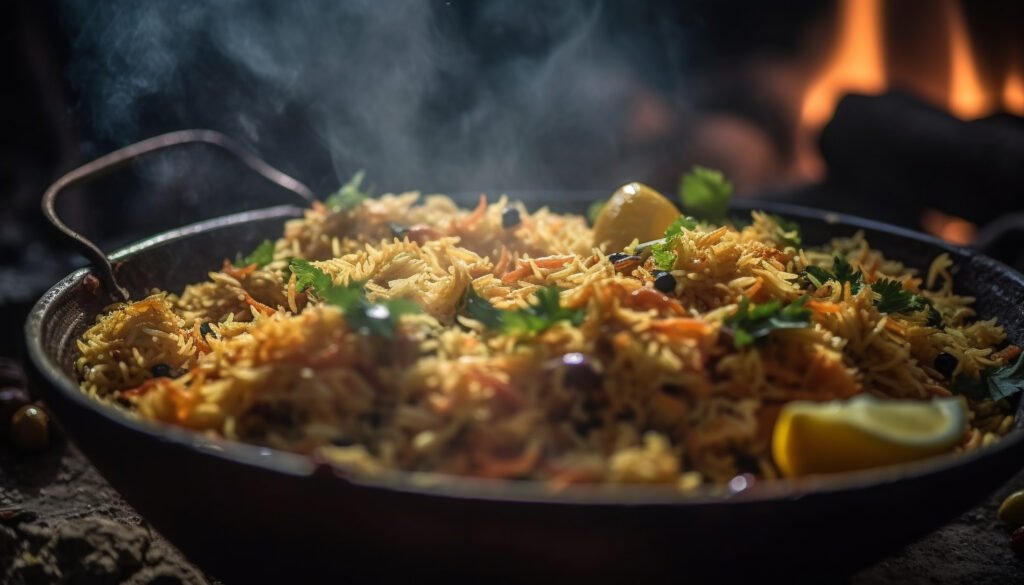
Not every plate called biryani has earned the name. Plenty of kitchens stir cooked rice into a curry, add a little food color and send it out. It can taste fine. But a real dum biryani is a different dish altogether, and once you know the signs, you can tell the two apart before you finish your first spoonful.
At Krish’s Indian Bistro in Sewell, NJ, biryani is one of the dishes guests come back for, so we take the method seriously. You can read our story on the best biryani in Sewell, NJ, and here is how to judge any biryani like someone who grew up eating it. It is also one of the reasons we are known as a halal Indian restaurant in South Jersey.
What Does “Dum” Actually Mean?
Dum comes from a Persian word that means breath or steam. Dum pukht, the full name of the technique, means to cook on slow steam.
Partly cooked rice and marinated meat are layered in a heavy pot. The lid is sealed, traditionally with a rope of dough, and the pot sits on very low heat, sometimes with hot coals on the lid as well. Nothing escapes. The meat releases steam, the steam rises through the rice, and everything finishes cooking together in its own aroma.
The method is linked to the royal kitchens of Lucknow and Hyderabad, and it has barely changed in a few hundred years.
7 Signs Your Biryani Was Cooked the Dum Way
1. The Rice Grains Are Long and Separate
This is the first thing to check. In a true dum biryani, every grain of basmati is long, whole and separate from the next. You should be able to pick up a single grain.
If the rice is clumpy, broken or sticky, it was either overcooked or stirred in a pan.
2. The Color Is Uneven
Look closely. Real dum biryani is never one flat color. You will see white grains, pale yellow saffron grains and deeper brown ones from the masala, all mixed together.
That patchiness is the proof of layering. Rice that is the same shade of orange from top to bottom has been tossed in sauce or coloring. Want to see what it should look like? Browse our food gallery.
3. The Aroma Hits You First
Because the pot is sealed, all the fragrance is trapped inside until the moment it is opened. A good biryani announces itself before it reaches the table: saffron, fried onion, mint, cardamom and warm ghee.
If you have to lean in to smell anything, the steam was lost somewhere along the way.
4. The Meat Is Tender to the Bone
Dum cooking is gentle and slow. Chicken should pull apart with a spoon. Goat or lamb should come away from the bone without a fight. And when you bite in, the flavor should be inside the meat, not just on the surface.
Dry or chewy meat with tasty rice usually means the two were cooked separately and combined at the end.
5. It Is Moist but Not Wet
There should be no puddle of gravy at the bottom of the plate. Dum biryani is juicy because the rice has absorbed the moisture, not because it is sitting in sauce.
At the same time, it should never be dry. Each spoonful should feel soft and lightly coated.
6. The Rice Itself Has Flavor
Try a few grains of plain white rice from the top with no meat and no masala. In a dum biryani, even those grains taste of spice and stock, because the steam carried the flavor up through the pot.
In a shortcut biryani, the white rice tastes like plain boiled rice.
7. You Find Whole Spices and Fried Onions
A bay leaf, a cardamom pod, a piece of cinnamon, a clove. Finding these is a good sign, not a mistake. They perfume the rice during cooking. Just move them to the side of your plate.
Dark, sweet fried onions and fresh mint scattered between the layers are another mark of the traditional method.
Signs of a Shortcut Biryani
- Rice that is the same color throughout
- Sticky, mushy or broken grains
- A greasy film of oil at the bottom
- Meat that looks like it came from a curry
- A strong smell of artificial biryani essence
- It arrives suspiciously fast and tastes like fried rice with curry
Kacchi vs Pakki: Two Kinds of Dum Biryani
There are two classic ways to do it, and both are authentic.
Kacchi biryani layers raw marinated meat with par-boiled rice, and the two cook together from scratch inside the sealed pot. It is the Hyderabadi way, and it takes real skill to get the timing right.
Pakki biryani uses meat that is already partly cooked in its masala before layering. It is more forgiving and common in Lucknowi and many North Indian styles.
Either way, the final stage is the same: sealed pot, low heat, slow steam.
Common Biryani Myths
A few misunderstandings follow biryani around, and clearing them up makes it easier to order well.
- Biryani is just spicy rice.” Heat is not the point. A good biryani is fragrant and layered, and chili is only one part of the picture.
- Biryani and pulao are the same.” Pulao is usually cooked in one pot, with the rice absorbing stock alongside the meat or vegetables. Biryani is built from separately prepared rice and masala, layered, and then finished on dum.
- A brighter color means a better biryani.” Strong, even orange or yellow often points to food coloring. Real saffron gives a soft, patchy tone.
- Every biryani must be very hot.” Regional styles range from mild and aromatic to fiery, so it is fine to ask for the level you like.
- You are supposed to eat the whole spices.” They are there for fragrance. Push them aside and enjoy the rice around them.
Why Dum Biryani Takes Time
Marinating, soaking rice, frying onions, layering and then 30 to 45 minutes of dum. It adds up to hours. That is why so many places skip it, and why biryani made properly tastes like nothing else on the menu.
How to Eat Biryani the Right Way
Biryani is a complete meal on its own. All it needs is a cooling raita and maybe a light gravy called salan on the side. Dig from the bottom of the serving so you get meat, masala and rice in every scoop, and do not mix it into a mash. The layers are the point.
Biryani at Krish’s Indian Bistro
At Krish’s Indian Bistro, we cook biryani with long-grain basmati, halal meat, whole spices and the patience the dish deserves. If it is your first visit, our guide on what to order at Krish’s is a good place to start.
Biryani is also one of the most requested dishes for catering and large tray orders, because it travels well and feeds a crowd. Ready to put these seven signs to the test? Order online or book a table at our halal Indian restaurant in Sewell.