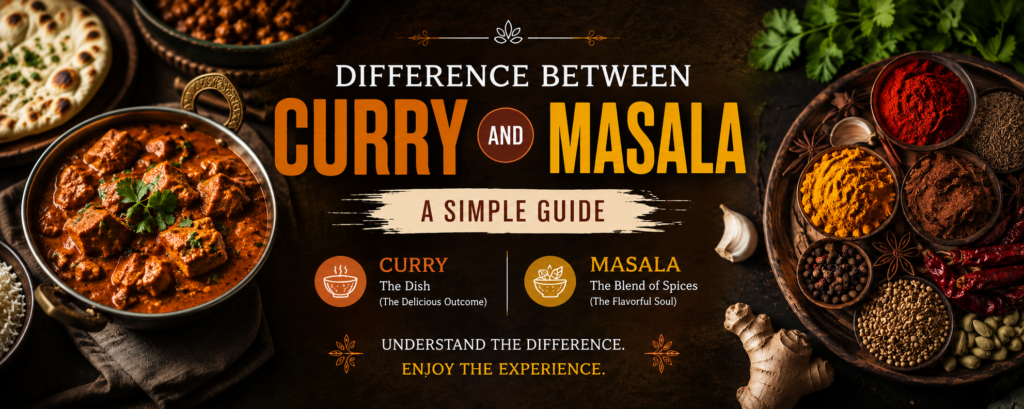
If you have ever looked at an Indian menu and wondered why one dish is called a “curry” and another a “masala,” you are not alone. These two words are thrown around so casually — sometimes even interchangeably — that many regular diners assume they mean the same thing. They don’t. Understanding the difference between curry and masala is the easiest way to read an Indian menu with confidence and know exactly what will land on your plate. This simple guide breaks it down in plain language, without the jargon.
What “Curry” Really Means
The word “curry” is one of the most misunderstood terms in food. In many Western kitchens, curry is treated as a single flavour — usually yellow, mildly spiced, and made from a jar of “curry powder.” But in India, there is no single dish called curry, and traditional Indian cooking rarely uses a generic curry powder at all. Instead, “curry” broadly describes any dish that has a sauce or gravy.
A curry can be creamy or thin, mild or fiery, tomato-based, yoghurt-based, coconut-based, or lentil-based. Some are rich enough to coat a spoon; others are light and soupy. In other words, curry is the finished dish — the saucy preparation you scoop up with rice or bread. It is an outcome, not an ingredient.
What “Masala” Really Means
“Masala” simply means a blend of spices. That’s it. It is not a dish; it is the seasoning that gives a dish its character. A masala can be a dry powder, like garam masala, or a wet paste made by grinding onions, garlic, ginger, tomatoes, and spices together.
So when a menu lists “Chicken Tikka Masala,” the word masala is telling you the chicken is cooked in a spiced sauce. Masala is the soul of Indian cooking — it is where the aroma, colour, and depth come from. Change the masala, and you change the entire personality of the dish.
Also Read: 5 Reasons Krish’s Is the Best Halal Indian Restaurant in South Jersey
The Core Difference Between Curry and Masala
Here is the simplest way to remember it: masala is what you cook with, and curry is what you end up with. The difference between curry and masala is essentially the difference between an ingredient and a finished dish. Masala is the spice blend or paste; curry is the sauced meal that the masala helps create.
Every good curry contains a masala, but not every masala becomes a curry. Some masalas are used to marinate meat, some are sprinkled on top as a finishing touch, and others flavour dry dishes with no gravy at all. Keep that one line in mind and the confusion disappears instantly.
How a Masala Turns Into a Curry
Most Indian curries begin the same way. Oil is heated, whole spices are added, then onions, ginger, and garlic are cooked down. Next come tomatoes and ground spices — the masala — which are slowly cooked until the oil separates, a stage known as “bhuna.” This deeply cooked masala becomes the flavour base.
Only then is the main ingredient — chicken, paneer, lentils, or vegetables — added, along with water, cream, or yoghurt to form the gravy. That gravy is the curry. So the masala does not simply sit on top of the dish; it dissolves into it and becomes its backbone. This is exactly why a rushed masala always leads to a flat-tasting curry.
Also Read: Which Indian Restaurants Offer the Best Large Tray Catering and Takeout in NJ?
The Masalas Worth Knowing
A few spice blends appear again and again across Indian kitchens:
- Garam masala — a warming finishing blend of cardamom, cloves, cinnamon, and pepper.
- Tandoori masala — used to marinate meats cooked in a clay oven.
- Chaat masala — a tangy, salty mix for snacks and salads.
- Chana masala — the spice blend behind the popular chickpea dish.
At Krish’s Indian Bistro, each of these blends is prepared with care, because the quality of a masala decides the quality of everything built on top of it. When the spice base is right, the curry almost takes care of itself.
Curries You’ll Spot on the Menu
On the curry side, you will notice enormous variety:
- Butter chicken — mild, creamy, and tomato-rich.
- Rogan josh — an aromatic lamb curry from Kashmir.
- Korma — a gentle, nutty, yoghurt-based gravy.
- Vindaloo — fiery and tangy, for those who love heat.
Each of these is a curry, and each relies on its own masala. That is why two curries from the same kitchen can taste completely different — the sauce base changes even when the technique stays similar.
Why the Two Get Confused Abroad
Outside India, the mix-up happened for practical reasons. British-era “curry powder” tried to bottle the flavour of Indian food into a single jar, and the name stuck. Menus were simplified for new audiences, and “masala” became just another word diners saw without fully understanding it. The team at Krish’s Indian Bistro often finds that once guests learn the difference between curry and masala, they start ordering more adventurously — and enjoy their meal far more, because they finally know what to expect.
How to Order With Confidence
Now that the terms make sense, ordering becomes easy. If a dish name ends in “masala,” expect a spiced, saucy preparation. If you want something with plenty of gravy to soak up with naan or rice, look for a curry. And if you prefer dry, grilled flavours, look for tandoori or tikka dishes, where the masala is used as a marinade rather than a sauce. This one small distinction turns a confusing menu into a simple map.
Conclusion
The difference between curry and masala is not complicated once you strip away the marketing and mystery. Masala is the spice blend that flavours the food; curry is the saucy dish that spice blend helps create. One is the ingredient, the other is the outcome — and together they form the beating heart of Indian cooking. The next time you scan a menu, you’ll read it like someone who genuinely understands the food.
Craving a plate that shows exactly what great masala and a well-made curry should taste like? Reserve your table at Krish’s Indian Bistro today and taste the difference for yourself.